

Key Takeaways
Achieving affective trust doesn’t happen through a single initiative, but rather with an operating model for equitable healthcare.
Across clinical research, care delivery, technology, and marketing, trust determines whether systems actually work for the people they intend to serve.
Key takeaways from this guide include:

Affective trust is foundational to participation and outcomes. Emotional trust—rooted in empathy, consistency, and cultural relevance—drives engagement in care, research, and prevention.
Inclusive research strengthens both science and business performance.Representative trials reduce delays, improve data quality, accelerate timelines, and lower regulatory and financial risk.
Therapeutic-area engagement outperforms study-by-study outreach.Long-term engagement across disease areas builds familiarity, recognition, and sustained community relationships.
Community data reveals the “why” behind behavior.Sentiment, perception, and lived experience provide critical context that traditional datasets miss.
Technology should amplify relationships.When built with community input, technology can scale equity without sacrificing trust or personalization.
While healthcare experiences advancements like never before, it also faces a crossroads.
For all the innovation and investment, too many people are still overlooked—treated as statistics rather than as individuals. Disparities persist across outcomes, access, and experience. And while efforts to address equity have grown louder, many communities remain understandably skeptical: Who is healthcare really for?
Representation isn’t a box to check. On the contrary, it’s the foundation of care that works. When people don’t see themselves reflected in research, outreach, or provider networks, trust erodes. And without trust, even the most advanced interventions can fail to reach the people who need them most.
That’s why the future of healthcare depends on more than technology or policy change. It depends on relationships. On meeting people where they are. On building systems that include diverse communities and are shaped by them.
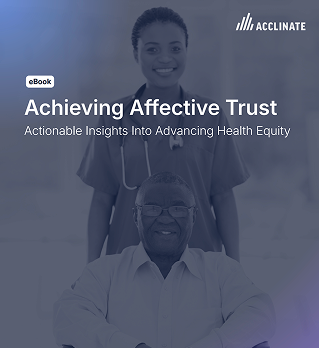
Here, we explore how affective trust—emotional trust rooted in respect, cultural relevance, and lived experience—can help forge crucial relationships that bridge gaps in healthcare access, clinical research participation, and health outcomes. In this guide, affective trust refers to the measurable confidence communities place in healthcare organizations when they feel seen, heard, and respected.

Table of Contents
Chapter 1: Reimagining Representation in Healthcare with Theraputic-Level Engagement
Chapter 2: The Economic Power of Inclusive Research
Chapter 3: Building Resilience Through Inclusive Research
Chapter 4: Centering Trust in Value-Based Care
Chapter 5: Trust in Healthcare is a Two-Way Street
Chapter 6: Technology’s Role in Scaling Health Equity
Chapter 7: Health Marketing That Listens and Connects
Chapter 8: Inclusive Teams, Smarter Science
Chapter 9: Community Data as a Compass for Health Equity Solutions
Chapter 10: Why Personalized Medicine Hinges on Equitable Research
Conclusion
Reimagining Representation in Healthcare with Therapeutic-Level Engagement

Study-specific outreach has long been the norm in clinical research. Sponsors fund short-term campaigns to recruit participants for a single trial—only to walk away once enrollment closes. This model may serve some immediate recruitment needs, but it doesn’t build sustainable relationships. And without those connections, trust and participation lag.
That’s where therapeutic-area (TA) engagement offers a smarter path forward. Rather than only activating outreach for each individual study, organizations invest in long-term engagement across a disease area—like oncology, cardiology, or maternal health. This approach maintains continuity, builds recognition, and allows communities to see the sponsor as a partner rather than a visitor.
A Real-World Model
Imagine a sponsor running multiple lung cancer trials over five years. Instead of launching ten separate outreach campaigns, the organization supports year-round community education and advocacy around lung health. It hosts informational events, partners with local leaders, and develops digital content—all designed to raise awareness and build presence in the space.
When a new trial launches, potential participants already know the sponsor. They’ve attended an event, heard from a peer, or read an article. Conversion happens faster because the groundwork has been laid. Even better, insights gathered during engagement can inform recruitment, protocol design, and retention strategies.
Sustainable Impact
TA-level engagement also unlocks shared-cost models. Multiple studies can contribute to a common engagement pool, making the strategy financially viable and often more efficient. And because these efforts don’t solicit protected health information, they can begin well before trials start—helping sponsors build equity into their pipelines, not only their campaigns.
Representation in healthcare works best when it’s familiar. When participants don't feel recruited, but respected. When trials invest in connecting with communities for the long term. Therapeutic-level engagement isn’t a new tactic. It’s a better way of doing the work.
The Economic Power of Inclusive Research in Clinical Trials

The idea that inclusion is a cost center is outdated. Today, inclusive research is one of the most strategic moves a sponsor can make. When trials reflect the people they’re meant to serve, results are more accurate, risks are lower, and long-term costs shrink dramatically.
Lack of representation creates inefficiencies at every level, from trial delays and under-enrollment to missed side effects and post-market safety issues. Each of these setbacks comes with a financial hit, whether it’s additional recruitment spend or regulatory scrutiny. Inclusive research avoids those detours by getting it right the first time.
Better Inputs, Smarter Outputs
The success of precision medicine relies on high-quality, diverse data. If clinical trial populations don't reflect the full range of real-world variation—such as different genetic profiles, co-existing health conditions, or socioeconomic backgrounds—then treatments developed from those trials may not be truly precise or applicable to everyone. That isn't just a research issue; it's a significant market risk.
For example, the CDC reports Black Americans are more likely to die from heart disease than White Americans—a disparity shaped by more than genetics. Race and ethnicity offer critical insight into how lived experience, culture, and systemic barriers influence health.
But representation goes beyond race alone. Age, gender, genomics, environment, and other factors all shape outcomes. Without accounting for these intersecting variables, we’re left with an incomplete, and often inaccurate, picture of health.
By expanding who is included in trials, sponsors not only improve the robustness of their science but expand their commercial reach. A broader participant pool can signal broader therapeutic applicability, fueling confidence from regulators, payors, and physicians.
A New Bioscience ROI Model
When inclusion becomes central to trial design, everything improves. Recruitment accelerates, messaging resonates, and drop-off rates decline. Participants feel heard and understood, leading to higher retention and richer data. These improvements translate into tangible financial savings and faster timelines.
Equity also builds reputational capital. Sponsors seen as responsible, community-centered, and culturally competent gain trust faster. And in an unprecedentedly connected world—where public scrutiny, social media, and patient advocacy wield influence—reputation is currency.
Redefining Value in Clinical Research
Ultimately, inclusion is as much a moral imperative as it is about building durable value—scientific, financial, and human. When trials center diverse experiences, the therapies they produce are more universally effective. And that, in turn, helps build a healthier, more equitable future for all.
Building Resilience Through Inclusive Research and Health Equity Strategies

Policy changes, political headwinds, and funding shifts can quickly alter health equity initiatives, clinical trial diversity programs, and community engagement strategies. But some principles, like advancing health equity, must remain steady, especially when external pressures threaten to erode them. In early 2025, the repeal of federal DEI initiatives sent shockwaves through the healthcare industry. For many, it raised the question: Do these actions put a pause on health equity initiatives?
At Acclinate, the answer we heard from our partners was clear: absolutely not. Instead of retreating, many redoubled their commitment. Not just because inclusion is the right thing to invest in, but because it makes their operations more resilient.
“Do these actions put a pause on health equity initiatives? Absolutely not.”
Resilience Starts With Representation
Inclusive research strategies embed organizations in the very communities they aim to serve. That proximity means stronger communication pipelines, deeper cultural insight, and more responsive systems. During times of instability, these relationships act as an anchor—helping organizations adapt quickly and ethically without losing trust.
Inclusive practices also generate diverse internal perspectives. When decision-makers reflect different lived experiences, they’re better equipped to anticipate risk, challenge bias, and lead through change. Resilience, in this context, goes beyond capacity to leverage real-world connections.
Ethical, Scientific, and Operational Alignment
Many healthcare companies have spent years building equity-focused departments, hiring DEI leaders, and creating infrastructure to support inclusive research. To abandon those efforts now would not only waste resources—it would signal that equity was never a real priority. Fortunately, many sponsors have made it clear: they won’t go backward.
These leaders understand that their stakeholders—patients, employees, regulators, and investors—are watching. Aligning business practices with community needs shouldn’t just be considered a marketing move. It’s literally better for science. It streamlines the full research cycle. And it’s how resilient, future-proof organizations operate
Health Equity: The Long View
The most successful organizations are those that stay grounded when the winds shift. Inclusive research is the foundation of successful clinical trials. And it builds the kind of reputation and responsiveness that helps sponsors weather storms.
Investing in representative research today helps organizations navigate tomorrow—whatever that might bring.
Centering Trust in Value-Based
Care to Improve Outcomes

In value-based care models, trust functions as both a clinical and operational variable, influencing adherence, engagement, and measurable outcomes. Without trust, care plans fall apart, adherence declines, and patient relationships fracture—especially in communities with long histories of being ignored or mistreated by the healthcare system.
At Acclinate, we see trust not as a byproduct of good care, but as a core input. Without it, even the most data-driven strategies struggle to connect.
Affective Trust in Action
Affective trust—emotional trust grounded in empathy, consistency, and cultural understanding—is at the heart of our framework. It’s what drives participation in preventive screenings, follow-up visits, and clinical trials. It’s what makes patients feel safe sharing their full story.
When providers build affective trust, outcomes improve—not just clinically, but holistically. Patients feel respected and heard. That emotional safety creates a ripple effect across the care journey.
Beyond the Metrics
Most value-based care models prioritize quantifiable outcomes: fewer readmissions, higher preventive care utilization, and better chronic disease management. But metrics alone don’t tell the full story. They don’t capture the “why” behind disengagement—or the invisible barriers created by fear, misunderstanding, or past trauma.
By centering trust, organizations gain new visibility into these hidden factors. And once seen, they can be addressed.
Trust as Value-Based Care Strategy
Trust can be your greatest strategic lever. It can reduce friction across care teams, improve shared decision-making, and mitigate provider burnout. It turns healthcare from a system patients navigate reluctantly into a relationship they value.
For value-based care to succeed in underrepresented communities, trust can’t be an afterthought. It must be the foundation.
Trust in Healthcare is a Two-Way
Street

Many healthcare organizations have historically approached community engagement as a checklist: show up, offer a screening, pass out flyers, and leave. But real engagement—the kind that builds representation in healthcare—requires more than moments. It requires presence, consistency, and humility.
We’ve heard the same refrain in cities and towns across the country: “Don’t just come here, plant your flag, and leave.” That insight, shared with Acclinate in our early days, became a guiding principle.
Leading With People, Not Programs
At Acclinate, we don’t lead with agendas. We lead with listening. Our community work isn’t about convincing people to say yes, but rather showing them we’re here for the long term, regardless of the outcome.
We partner with trusted messengers—coaches, faith leaders, HBCU alumni—who already have earned credibility. And we show up consistently, even when we’re not asking for anything. That’s how you build relationships that last beyond a single campaign.
Rethinking Success
Traditional healthcare engagement often defines success by enrollment numbers or event turnout. But we measure success differently: by how many people feel heard, how many questions are answered, how many conversations lead to new ideas or shifted perspectives.
Sometimes the most powerful outcome is not a yes, but a “maybe later.” Why? Because that maybe signals an openness—an emerging willingness to trust.
Long-Term Health Equity Infrastructure
For engagement to be sustainable, it must be supported by infrastructure—funding, leadership alignment, and internal accountability. At Acclinate, we work with organizations to shift from short-term initiatives to long-term strategies. Those that are connected to business outcomes, not just community optics.
Trust isn’t built in a day. But over time, piece by piece, it becomes the foundation for the rest of our healthcare system.
Technology’s Role in Scaling Health Equity and Inclusive Research

In healthcare, innovation moves fast—but equity often lags behind. The challenge isn’t a lack of technology. It’s a lack of alignment between tools and the communities they aim to serve. That’s why Acclinate doesn’t build tech in a vacuum. We build it in partnership—with people, with purpose, and with a clear focus on advancing health equity.
Technology can only scale trust if it starts with trust, ethical data practices, and community-informed design.
Designed With, Not For
Our approach to product development is grounded in real-world feedback. Before building a feature, we ask: Would this actually help? Is it intuitive? Does it reflect the way people live, speak, and engage with health?
We host live focus groups. We listen to language patterns, cultural cues, and barriers to engagement. This feedback directly shapes how our platforms function. That’s how our mobile app and predictive models were born—not as flashy solutions, but as practical answers to questions real people asked.
“Would this actually help? Is it intuitive? Does it reflect the way people live, speak, and engage with health?”
Our Participation Probability Index (PPI)
One example is our proprietary Participation Probability Index (PPI), which helps predict clinical trial engagement using information from our own communities—not recycled datasets. This model allows us to understand and anticipate engagement patterns while respecting the nuance of lived experience.
We don’t use AI to replace relationships. We use it to amplify them—helping organizations act on insights more quickly and with greater cultural precision.
Scaling With a Human Touch
As organizations look to scale inclusive health solutions, the challenge becomes maintaining personalization without losing connection. That’s why Acclinate blends community insight with thoughtful technology—anchoring all efforts in trust and relevance.
Rather than automating outreach for efficiency alone, Acclinate listens first. Community input helps shape what gets built, how it's used, and why it matters. Our approach emphasizes culturally responsive design, ethical data collection, and inclusive strategy development grounded in real-world feedback.
Through ongoing dialogue, we ensure that growth doesn’t come at the cost of connection. At every stage, we ask: Does this reflect the community? Are we still listening?
That’s how technology becomes a tool for equity.
Health Marketing That Listens and Connects With Communities

Healthcare marketing has historically been a top-down function. Brands craft messages, push them out, and hope they resonate. At Acclinate, we flip that model. Our marketing doesn’t start with a message—it starts with listening.
From health summits to neighborhood festivals, our campaigns are shaped by what communities tell us they need, not what we assume they want. This people-first approach ensures that our messages feel familiar, relevant, and trustworthy, reflecting emerging best practices in health equity communications and culturally competent care.
Meeting People Where They Are
We don’t wait for people to come to us. We go to them. Whether it’s a digital campaign, a church-based event, or a barbershop activation, we design outreach that reflects how different communities already engage with health.
And because cultural nuance matters, we adapt our language, tone, and visuals to fit the audience. What resonates with a Black Gen Z college student may differ significantly from what connects with a Spanish-speaking grandmother. We honor those differences.
Metrics That Matter
While we track engagement, reach, and conversions like any marketing team, we also measure qualitative feedback. Did someone feel respected? Did a message spark a conversation? Did an event change someone’s perception of research?
This blended approach—quantitative and qualitative—helps us ensure that our marketing doesn’t just inform but inspires.
From Outreach to Outcome
Marketing at Acclinate is more than brand visibility. It’s about representation in healthcare—making sure communities see themselves reflected in clinical research and care messaging.
When people feel seen, they engage. And when they engage, everything from recruitment to retention improves.
Inclusive Teams, Smarter Science in Clinical Research

When research teams lack diversity, so do their ideas. The result? Study designs that overlook key populations, eligibility criteria that unintentionally exclude, and interventions that fail to resonate with those most in need.
At Acclinate, we’ve seen how representative research begins behind the scenes. The makeup of the team often shapes the makeup of the trial. And without inclusion at the foundation, bias creeps in—whether anyone realizes it or not.
Real-World Consequences
Consider a study that excludes participants taking a commonly prescribed drug. If that drug is widely used in a specific population—such as steroids in sarcoidosis patients—you’ve effectively blocked the very people most affected by the disease from participating.
Inclusive teams ask different questions. They design with broader vision. And they challenge default settings that often leave communities out of the equation.
More Voices, Better Outcomes
Representation drives better science. It ensures that protocols reflect the complexity of real life—not the convenience of lab conditions. It improves generalizability, increases regulatory confidence, and minimizes costly revisions down the line.
And it doesn’t slow the process. It strengthens it. When teams are diverse, blind spots shrink and creativity expands.
Representation at Every Layer
From community advisors to principal investigators, everyone involved in the research ecosystem plays a role. At Acclinate, we work with sponsors to diversify their participant pools, but also the teams responsible for the work.
That’s how we ensure the future of medicine reflects all the people it’s meant to serve.
Community Data as a Compass for Health Equity Solutions and Trust Insights

Most healthcare data tells you what happened, but community-derived data helps explain behavioral drivers, trust dynamics, and barriers to participation. It brings nuance to trends, uncovering the emotional, cultural, and logistical realities that shape behavior.
That’s why Acclinate collects both quantitative and qualitative insights. We want to know not just whether someone missed an appointment, but also whether it was because they didn’t trust the provider, couldn’t find transportation, or had never been asked the right questions.
The Power of Sentiment
By tracking community sentiment—trust levels, perception of clinical trials, understanding of disease—we help healthcare organizations tailor strategies that actually work. In one campaign, for instance, we found that 80% of respondents were open to participating in research—if approached in a culturally competent way.
This insight shifted the entire outreach model, revealing opportunity where others assumed resistance.
of respondents were open to participating in research.
Ethical and Effective
All of our data is de-identified, aggregated, and protected. We don’t collect to extract. We collect to illuminate—helping researchers, sponsors, and care teams make smarter, more ethical decisions.
And we take cultural competency seriously. How a question is asked can impact the answer. So we partner with local leaders to shape the language and delivery of our surveys and interviews.
Data That Changes Direction
Sometimes the most valuable insights come from outliers. A spike in RSV content engagement in one city. A sudden shift in vaccine sentiment. These aren’t anomalies—they’re signals.
By paying attention, we help healthcare organizations move faster, adjust smarter, and serve communities more effectively.
Why Personalized Medicine Hinges
on Equitable Research and Representative Data

Personalized medicine is changing how we think about treatment. But the success of this shift depends entirely on data. If the data is narrow, the personalization is flawed.
Equitable research ensures that precision medicine is supported by representative datasets that reflect real-world populations.
For precision therapies to reach their full potential, clinical research must include people from every background. Because disease doesn’t discriminate—but data gaps do.
The Role of Representation
When trials are inclusive, they capture more genetic variation, social determinants of health, and cultural influences. That’s what turns good science into great care.
We’ve seen this in action with conditions like sickle cell disease, asthma, and hypertension—where treatments developed through inclusive trials deliver better outcomes for the people most affected.
Social Determinants Matter Too
Equity in personalized medicine isn’t just about biology. It’s about context. A patient’s housing, income, access to food, and exposure to pollution all affect how a treatment works, and whether it’s even accessible.
Inclusive research integrates these variables from the start. And that makes care more real, more practical, and more effective.
A Collective Responsibility
Everyone has a role: researchers, payors, policymakers, clinicians. Building equity into research design, recruitment, and policy isn’t optional—it’s foundational.
Because without equitable data, personalized medicine risks becoming precision for some—and guesswork for everyone else.

Health Equity as the Engine of
Progress in Clinical Research

Across every insight, one truth rises above the rest: advancing health equity is not an initiative. It’s the way forward. Together, these concepts demonstrate that advancing health equity requires coordinated action across research, care delivery, technology, and community partnership.
Health equity commitments can fuel smarter science, stronger businesses, and healthier communities. They improve outcomes and reduce risk. And most importantly, they ensure that healthcare systems serve all people—not just the ones easiest to reach.
At Acclinate, this truth is more than a mission. It’s our model. We build relationships. We gather insight. We create solutions rooted in trust and delivered with purpose.
When equity leads, the rest of healthcare gets better.
Ready to work together? Let’s build a future where trust, inclusion, and innovation drive better health for all. Schedule a 1:1 with our team to get started.
Frequently Asked Questions (FAQ)
What is affective trust in healthcare?

Affective trust refers to emotional trust built through empathy, respect, cultural understanding, and consistent engagement. Unlike transactional trust traditional to clinical trials, it focuses on understanding how people experience healthcare systems and leveraging familiar partnerships to build bridges.
Why is affective trust important for clinical research?
Without trust built on authentic connection, participation declines and data quality suffers. Affective trust increases enrollment, improves retention, and ensures research reflects real-world populations rather than narrow sample groups.
How does inclusive research improve ROI?
Inclusive research reduces costly delays, minimizes post-market safety issues, improves regulatory confidence, and accelerates timelines—making it both scientifically and financially resilient.
What is therapeutic-level engagement?
Therapeutic-level engagement focuses on long-term connection within a disease area (e.g., oncology or cardiology) rather than short-term recruitment for individual studies. This approach builds familiarity and sustained trust over time.
How does Acclinate collect community data ethically?
All data is de-identified, aggregated, and gathered with cultural competence. Acclinate partners with community leaders to ensure questions are asked respectfully and insights are used responsibly.
Can technology really help scale trust?
Yes—but only when it’s designed with communities, not just for them. Acclinate uses technology to enhance cultural precision and responsiveness, while keeping human relationships at the center.